
Frigid conditions to persist as Delhi logs coldest day since ‘20
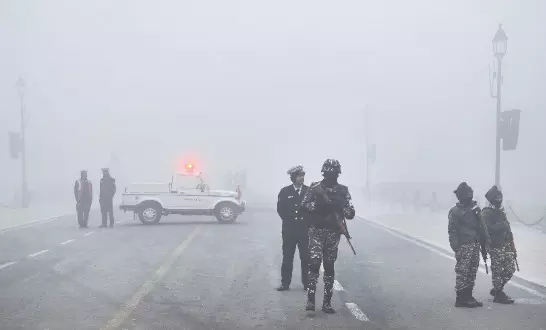


New Delhi: A sharp cold wave tightened its grip on the capital on Wednesday as cold day conditions prevailed alongside dense fog, while air quality remained firmly in the very poor category, according to official data.
The India Meteorological Department said the city recorded a maximum temperature of 14.2 degrees Celsius, which was 6.2 degrees below the seasonal average and the lowest daytime temperature seen since 2020. Several weather stations reported even lower readings. Palam logged a maximum of 13.6 degrees Celsius, Lodhi Road 13.4 degrees Celsius, the Ridge 13.8 degrees Celsius and Ayanagar 13.1 degrees Celsius.
The minimum temperature stood at 6.4 degrees Celsius, marginally below normal. Station-wise data showed Palam recording a low of 7.7 degrees Celsius, Lodhi Road 6.8 degrees Celsius and the Ridge 7.8 degrees Celsius.
IMD officials said cold day conditions are declared when the minimum temperature falls below 10 degrees Celsius and the maximum remains around 4.5 degrees below normal. The department forecast a generally cloudy sky with light rain on January 1, with cold day conditions expected to continue.
“There is a slight chance of very light and isolated rain over Delhi and the NCR between tonight and New Year’s Day due to an induced cyclonic circulation over Punjab and Haryana. If it occurs, this could be the season’s first spell of rain,” Mahesh Palawat of Skymet said.
From January 3, coldwave conditions may develop as minimum temperatures could dip below 5 degrees Celsius, with cold northerly winds from the Himalayan region expected to move towards the capital, he added.
Dense fog disrupted visibility across several areas during the morning hours. Safdarjung reported visibility dropping to 50 metres between 6.30 am and 7.30 am, improving to 100 metres by 8 am. At Palam, visibility was as low as 50 metres from 4 am to 7.30 am, later improving to 150 metres.
IMD scientist Dr Naresh Kumar said dense to very dense fog has persisted over north India for nearly two weeks and may occur at isolated places in Delhi again on Thursday morning. He attributed the weather to an active western disturbance over north Pakistan, which is expected to bring light to moderate rain and snowfall over the western Himalayan region for the next two to three days, with very light rain possible over the NCR.
Air quality continued to be a concern. The 24-hour average Air Quality Index stood at 373, placing it in the very poor category. Data from the Central Pollution Control Board showed 23 monitoring stations in the very poor range and 14 in the severe category. ITO recorded the highest AQI at 433 in the evening, while Anand Vihar touched 452 during morning hours.
Officials attributed the situation to weak dispersion conditions, with an unfavourable ventilation index below 6,000 square metres per second and wind speeds under 10 kmph. Forecasts indicate air quality is likely to remain very poor until at least January 3.



