
Eco Survey projects resilient growth, low inflation amid rising global risks
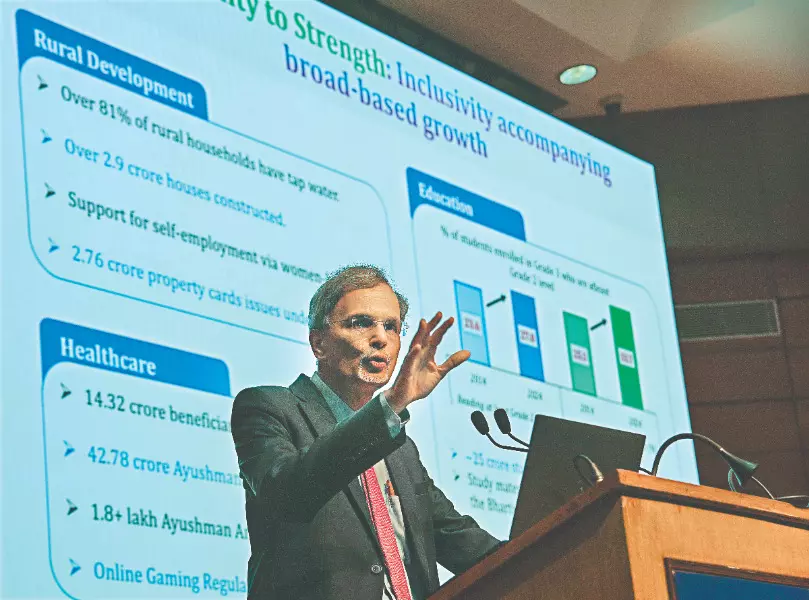


New Delhi: India’s economy is expected to expand by between 6.8 per cent and 7.2 per cent in the financial year beginning April, according to the Economic Survey 2025–26 tabled in Parliament on Thursday, underscoring the country’s position as the world’s fastest growing major economy even as global trade tensions, geopolitical uncertainty and financial volatility cloud the outlook.
The projection for 2026–27 marks a moderation from the estimated 7.4 per cent growth in the current fiscal year, driven largely by consumption and investment. Still, the survey said a series of structural reforms over recent years have lifted India’s medium-term growth potential closer to 7 per cent, compared with an estimated 6.5 per cent three years ago, reflecting efficiency gains and improved economic resilience. “The outlook, therefore, is one of steady growth amid global uncertainty, requiring caution, but not pessimism,” the report said.
As per National Statistics Office estimates, India’s economy grew 7.4 per cent in the ongoing fiscal, making it the fastest growing major economy for the fourth consecutive year. The survey’s growth estimate for the year ahead is higher than the 6.3–6.8 per cent range projected a year earlier, even as it factors in risks arising from heightened trade friction with the United States.
India currently faces tariffs of up to 50 per cent on certain goods exported to the US and remains one of the few large economies yet to sign a bilateral trade deal with Washington. The survey noted that these tariffs have weighed on labour-intensive sectors and contributed to a nearly 5 per cent depreciation in the rupee, which it described as “punching below its weight”. At the same time, it said the currency’s undervaluation partly offsets the impact of higher US duties on Indian exports. “The rupee’s valuation does not accurately reflect India’s stellar economic fundamentals,” the report said.
To counter external headwinds, the government has undertaken a series of policy and tax reforms, including cuts in GST rates, raising the threshold for income tax liability, overhauling labour laws to ease compliance for businesses, and concluding four free trade agreements since May 2025, including a major pact with the European Union. The survey said these steps, along with Production-Linked Incentive schemes and other measures to boost manufacturing competitiveness, have raised India’s growth potential.
Inflation conditions remain supportive, with domestic inflation averaging 1.7 per cent during April to December 2025. The survey said core inflation pressures were largely driven by precious metals prices and that excluding these, price pressures remain muted. It added that the outlook is favourable due to strong agricultural output and a gradual pass-through of GST reductions. Balance sheets of firms and households are healthier, and consumption demand continues to show resilience, it said. International agencies, however, see a more modest expansion if global trade tensions persist. The International Monetary Fund has forecast 6.2 per cent growth for India in the coming year should steep tariffs remain in place, while the World Bank and the Asian Development Bank project growth of about 6.5 per cent. These compare with the survey’s higher estimate of up to 7.2 per cent. The document, authored by Chief Economic Adviser V Anantha Nageswaran, said ongoing trade negotiations with the US are expected to conclude during the year, which could help reduce external uncertainty. It also highlighted heightened geopolitical risks, including shrinking space for rules-based trade, the growing use of export controls in critical sectors, and the weaponisation of energy supplies.
Referring to the global environment, the survey said the world economy has been subjected to “multiple upheavals”, with the imposition of tariffs by the US on imports from its trade partners described as the most disruptive. It noted that strategic competition is fuelling trade wars, with nations vying for access to critical minerals and technologies in a manner reminiscent of a new colonial scramble. Economic interdependence, once seen as a source of stability, is increasingly viewed as a channel of vulnerability, it said.
Against this backdrop, the survey called for India to focus on building enduring national capabilities and economic sovereignty. It advocated a disciplined approach to “Swadeshi”, describing it as inevitable and necessary in an era marked by export controls, technology denial regimes, carbon border measures and inward-looking industrial policies globally. While cautioning that not all import substitution is feasible or desirable, it said Swadeshi should aim to move India from self-reliance to strategic indispensability, supported by a National Input Cost Reduction strategy. On public finances, the survey said revenue buoyancy has remained robust in the current fiscal year, with strong growth in both direct and indirect tax collections. In particular, non-corporate tax collections, especially individual income taxes, have been growing faster than other components, reflecting changing dynamics in the tax mix and the impact of administrative reforms. It highlighted the significance of the new Income Tax legislation due to take effect from April 1, aimed at simplifying the tax structure, providing clarity and encouraging voluntary compliance.
At the same time, the survey flagged concerns over state finances. While the Centre has continued post-pandemic consolidation alongside record public investment, rising revenue deficits and unconditional cash transfers by several states pose emerging risks. In a post-survey media interaction, Nageswaran warned that fiscal indiscipline at the state level could affect sovereign borrowing costs, especially as Indian government bonds are now globally indexed and investors increasingly assess general government finances. India’s 10-year bond yield stands at about 6.7 per cent, compared with Indonesia’s 6.3 per cent, despite both having the same BBB credit rating.
Nageswaran said income transfers to households play a role but are most effective when complemented by productivity-enhancing investments. He cautioned that unconditional transfers could weaken incentives for self-improvement, upskilling and employability over the long term. He also flagged risks in global financial markets, pointing to stretched asset valuations, rising concentration risks and a shift towards less regulated sources of capital following years of ultra-loose monetary policy. He noted that India’s unemployment rate declined from 6 per cent to 3.2 per cent in 2023–24, with female labour force participation rising by nearly 18 percentage points.
Beyond macroeconomic issues, the survey identified shortcomings in export policies, particularly in agriculture. While India is the world’s second-largest agricultural producer by value, the report said frequent policy changes risk disrupting supply chains and driving foreign buyers to alternative sources. It said agricultural, marine, food and beverage exports could reach $100 billion within four years if stability is ensured. It also recommended steps to reduce the cost of capital and diversify financing sources beyond banks, including lowering taxes on debt instruments.
The survey ventured into social and technological domains as well, calling for age-based limits on access to social media apps to counter digital addiction, reducing dependence on online teaching tools in favour of offline engagement, and promoting simpler devices for children with content filters. It advocated restrictions on marketing of ultra-processed foods between 6 am and 11 pm and tighter rules on marketing of infant and toddler milk and beverages. It also cautioned against broader financial contagion if the artificial intelligence boom fails to deliver expected productivity gains, potentially leading to corrections in asset valuations.
Prime Minister Narendra Modi said the survey presents a comprehensive picture of India’s reform journey and highlights strong macroeconomic fundamentals, sustained growth momentum and the expanding role of innovation, entrepreneurship and infrastructure in nation-building. In a post on X, he said the document outlines a roadmap for strengthening manufacturing, enhancing productivity and accelerating progress towards becoming a developed nation.
Finance Minister Nirmala Sitharaman, who tabled the survey ahead of the Union Budget for 2026–27 to be presented on February 1, said India’s macroeconomic fundamentals are “stronger than ever” and that the country has successfully navigated global headwinds to place itself on a high-growth trajectory, with potential GDP growth now seen at 7 per cent.



