Delhi's air quality deteriorates to 'very poor' category
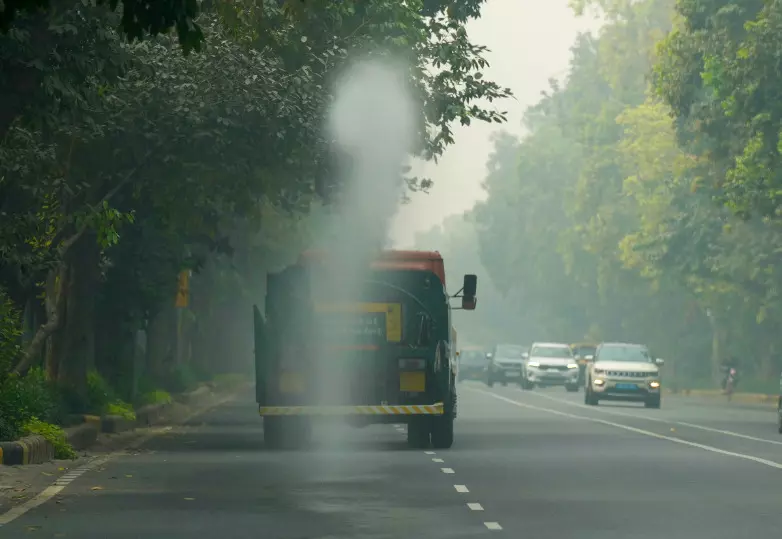


New Delhi: After staying in the 'poor' to 'moderate' category for almost a week, Delhi's air quality slipped back to 'very poor' category for the second time this month on Wednesday, with an AQI reading of 305, data showed.
The last time the Air Quality Index (AQI) was in the 'very poor' category was on February 4 at 339. On Tuesday, the AQI settled at 271 and on Monday it was recorded at 249.
According to the Central Pollution Control Board's classification, an AQI between 0 and 50 is 'good', 51 and 100 'satisfactory', 101 and 200 'moderate', 201 and 300 'poor', 301 and 400 'very poor', and 401 and 500 'severe'.
The air quality is likely to be in the 'poor' category from February 12 to 14, according to the Air Quality Early Warning System.
Meanwhile, the day temperatures saw a slight drop.
Safdarjung, the city's base monitoring station, recorded a maximum temperature of 27.5 degrees Celsius, 4.1 notches above normal. It was 28.6 degrees Celsius on Tuesday.
Palam station reported a maximum of 25.4 degrees Celsius, while Lodhi Road saw 27.1 degrees, both registering departures of 1.8 degrees and 4.1 degrees, respectively.
According to the India Meteorological Department (IMD), both Ridge and Ayanagar reported a maximum temperature of 27.6 degrees Celsius.
The minimum temperature recorded at Safdarjung was 13.2 degrees Celsius, three notches above normal.
Station-wise data showed that the minimum temperature was recorded at 14.4 degrees Celsius in Palam, 4.1 notches above the normal; 13.4 degrees Celsius at Lodhi Road, 4.4 notches above normal; 13.6 degrees Celsius at Ridge, 2.6 notches above normal, and 13.3 degrees Celsius at Ayanagar, 3.5 notches above normal.
The weather office also said that no rainfall was recorded in any part of the city during the 24-hour period ending 5.30 pm, with cumulative rainfall remaining at zero across all stations.
The IMD has also predicted a slight fall in minimum temperatures by one to two degree Celsius during the next two days and rise by two to three degrees Celsius thereafter.