Day 8: War with no off switch; Iran apologises to neighbours | Trump threatens hard strike
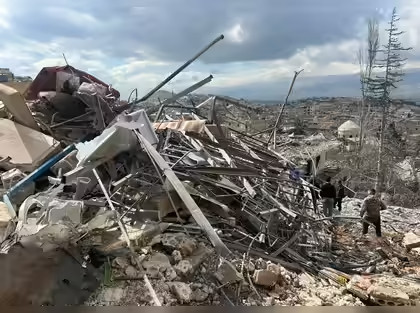


Dubai: US President Donald Trump on Saturday vowed to hit Iran “very hard’’, saying the US military is considering new targets in the country even as Iran’s president apologised for attacks on regional countries even as its missiles and drones flew toward Gulf Arab states.
The Iranian President Masoud Pezeshkian’s apology indicated that Tehran’s political leadership could not exercise full command over Iran’s armed forces. He also rejected President Trump’s repeated demands for surrender.
President Trump said that US military forces have “knocked out 42 Iranian navy ships’’ in three days, adding that the US is doing “very well’’ in Iran. Shortly after Pezeshkian’s message, Trump warned in a social media post that more Iranian officials would become targets in the war, writing: “Today Iran will be hit very hard!” In his comments on his Truth Social website, Trump noted the apology by Pezeshkian.
“Under serious consideration for complete destruction and certain death, because of Iran’s bad behaviour, are areas and groups of people that were not considered for targeting up until this moment in time,” Trump wrote, without elaborating.
Iranian President Pezeshkian, one member of a tripartite leadership council overseeing Iran since a Feb. 28 airstrike started the war and killed Supreme Leader Ayatollah Ali Khamenei, delivered the defiant message exactly one week into a conflict that has spread across the region, rattled global markets and air travel and left Iran’s own leadership greatly weakened by hundreds of Israeli and American airstrikes.
The message, seemingly filmed in a hurry without professional broadcast equipment, again underlined the limited powers being exercised by theocracy’s leaders over its paramilitary Revolutionary Guard, which controls the ballistic missiles targeting Israel and others. It answered only to Khamenei and now appears to be picking its own targets as the conflict widens.
While the Iranian president attempted to assuage growing Gulf Arab anger over the attacks, just hours earlier, a wave of missiles and drones had disrupted flights at Dubai International Airport, targeted a major Saudi oil facility and sent people fleeing for cover multiple times in Bahrain.
There was no foreseeable end to the fighting. Trump’s administration approved a new USD 151 million arms sale to Israel after Trump said he would not negotiate with Iran without its “unconditional surrender”, and US officials warned of a forthcoming bombing campaign they said would be the most intense yet in the weeklong conflict.
Iran’s UN ambassador said the country would “take all necessary measures” to defend itself.
Associated Press video showed explosions flashing and smoke rising over western Tehran as Israel said it had begun a broad wave of strikes.
The fighting has killed at least 1,230 people in Iran, more than 200 in Lebanon and 11 in Israel, according to officials in those countries. Six US troops have been killed.
In a sign of the widening nature of the conflict, sirens sounded early Saturday in Bahrain as Iranian attacks targeted the island kingdom. And Saudi Arabia said it destroyed drones headed toward its vast Shaybah oil field and shot down a ballistic missile launched toward Prince Sultan Air Base, which hosts US forces.
In Dubai, several blasts were heard Saturday morning, and the government said it had activated air defences. Passengers waiting for flights at Dubai International Airport found themselves ushered down into train tunnels at the sprawling airfield after the alert sounded.
Later that morning, long-haul carrier Emirates said that “all flights to and from Dubai have been suspended until further notice.” Shortly after, the decision was reversed, and Emirates said the airline would resume operations.
Qatar’s energy minister, Saad al-Kaabi, warned in an interview with the Financial Times that the war could “bring down the economies of the world,” predicting a widespread shutdown of Gulf energy exports that could send oil to USD 150 a barrel.
The price for a barrel of benchmark US crude rose above USD 90 on Friday for the first time in more than two years.
Writing for the Qatar-funded satellite news network Al Jazeera, a regional analyst warned Iran was making “a strategic miscalculation of historic proportions.”
Sultan al-Khulaifi, a senior researcher at the Centre for Conflict and Humanitarian Studies, wrote: “By spreading the conflict to the Gulf, Tehran is doing precisely what Israel could not do alone: steering the war away from the Israeli-Iranian axis and transforming it into a confrontation between Iran and its Arab neighbours.”