
Day 6: War continues...
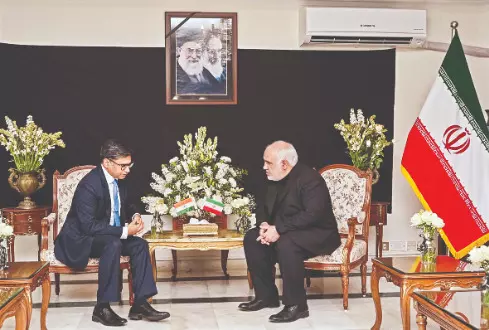


NEW DELHI/DUBAI: India on Thursday condoled the death of Iran’s Supreme Leader Ayatollah Ali Khamenei with Foreign Secretary Vikram Misri conveying to the Iranian Ambassador New Delhi’s message of sympathy.
Foreign Secretary Vikram Misri, on behalf of the Indian government, signed the book of condolence for Iran’s Supreme leader Ali Khamenei. The 86-year-old former Supreme Leader of the Islamic Republic of Iran, had been ruling the country since 1989 and was killed in a combined military operation launched by the United States and Israel in the early hours of Saturday.
“Sincerest condolences on behalf of the government and people of India. We pray for peace for the departed soul,” Misri wrote in the book as his condolence message. Misri’s action came as part of India’s first reaction to the Supreme Leader’s death.
Separately, Foreign Minister S Jasihankar also had a word with his Iranian counterpart, Seyed Abbas Araghchi, through a telephonic conversation. The Minister mentioned it in his X post.
India had so far remained silent over the death of Ali Khamenei. It has also refrained from condemning outright the US-Israeli strikes on Iran.
Misri’s visit to the Iranian embassy and signing of the condolence book assumed significance as several opposition parties had criticised the government for not reacting to Khamenei’s death. The move signs a subtle shift in the position of New Delhi, which had not condemned the airstrikes in which Khamenei died and maintained a studied silence in face of vehement Opposition demands for a formal statement.
PM Modi later expressed his concern about the situation in the middle-east. “India has always called for dialogue and diplomacy to find a solution to such disputes,” he said.
New Delhi’s reaction has been in line with that of most global powers, none of which had issued condolences for Khamenei’s killing - the only key nations to do so have been Russia and China.
The Opposition had earlier condemned Delhi’s stand, pointing to India’s long-standing relationship with Iran.
India at one point used to purchase 13 per cent of its oil from Iran and conducted significant trade, which had dropped sharply after US sanctions on Iran following its withdrawal from the nuclear deal in 2018.
Also, over the years since the NDA came to power, the government has cultivated its ties with Israel and now has a strong strategic, economic and military partnership with Tel Aviv.
Earlier this week, UPA chairperson and Congress leader Sonia Gandhi condemned the government’s stand, saying: “When the targeted killing of a foreign leader draws no clear defence of sovereignty or international law from our country and impartiality is abandoned, it raises serious doubts about the direction and credibility of our foreign policy”.
Meanwhile, Iran launched a new wave of attacks at Israeli and American bases and threatened that the United States would “bitterly regret” torpedoing an Iranian warship in the Indian Ocean and a religious leader called for “Trump’s blood,” while Israel said it had begun a “large-scale” attack on Tehran.
Israel announced multiple incoming missile attacks and air sirens sounded in Tel Aviv and Jerusalem. Iranian state television said additional strikes also targeted US bases.
The Israeli military said it had hit 80 targets in Lebanon linked to the Iranian-backed Hezbollah militant group over the past 24 hours and that a wave of strikes on Iran had hit long range ballistic missile launch sites and other targets.
Iranian Foreign Minister Abbas Araghchi accused the US Navy of committing an “an atrocity at sea” for sinking the Iranian frigate IRIS Dena in the Indian Ocean, which killed at least 87 Iranian sailors.
“Mark my words: The US will come to bitterly regret (the) precedent it has set,” he said on social media.Ayatollah Abdollah Javadi Amoli, in one of the few clerical statements so far from Iran, later called on state television for “the shedding of Zionist blood, the shedding of Trump’s blood.”
“Fight the oppressive America, his blood is on my shoulders,’” he said in a rare call for violence from an ayatollah, one of the highest ranks within the clergy of Shiite Islam.
The US and Israel launched the war Saturday, targeting Iran’s leadership and killing Iranian Supreme Leader Ayatollah Ali Khamenei, as well as hitting its missile arsenal and nuclear facilities. Leaders have suggested toppling the government is a goal, but the exact aims and timelines have repeatedly shifted, signalling an open-ended conflict.
The war has killed more than 1,000 people in Iran, more than 70 in Lebanon and around a dozen in Israel, according to officials in those countries. It has disrupted the supply of the world’s oil and gas, snarled international shipping and stranded hundreds of thousands of travellers in the Middle East.
A drone crashed near the airport in Nakhchivan, an Azerbaijan exclave bordering the north of Iran that is separated from the rest of the country by Armenia. Another drone fell near a school and two civilians were injured, Azerbaijan’s Foreign Ministry said.
Iran has not acknowledged targeting Azerbaijan, but its attacks since the start of the war have spread erratically and involved regional countries and beyond.
Qatar evacuated residents near the US Embassy in Doha as a temporary precaution and later reported a missile attack on the city. Saudi Arabia said it destroyed a drone in its province bordering Jordan.
A tanker apparently came under attack off the coast of Kuwait early Thursday, expanding the area where commercial shipping was in danger, according to the United Kingdom Maritime Trade Operations Centre run by the British military. It said there was an explosion but did not offfer a cause. Iran in the past has attacked ships by attaching limpet mines to them.
Prior attacks since fighting began Saturday have happened in the Gulf of Oman and the Strait of Hormuz, which connects it to the Persian Gulf and through which about a fifth of the world’s oil is shipped.
US and Israeli military officials say launches from Iran have declined as their attacks have taken out ballistic missiles, launchers and drones.
At least 1,045 people have been killed in Iran, the country’s Foundation of Martyrs and Veterans Affairs said. Eleven people have died in Israel. Six US troops have been killed, including a major whose identity was released Wednesday.
Among the 80 targets in Lebanon that the Israel military said it hit over the past 24 hours were “several command centres” used by Hezbollah in Beirut. It showed video footage of a building being hit, but provided no further details.
Another eight people were killed in Lebanon, including two in a building struck by the Israeli military in the Beddawi refugee camp in the coastal city of Tripoli on Thursday and three on a coastal highway, authorities said.
With Agency Inputs



