Day 4: War deepens, claims fly
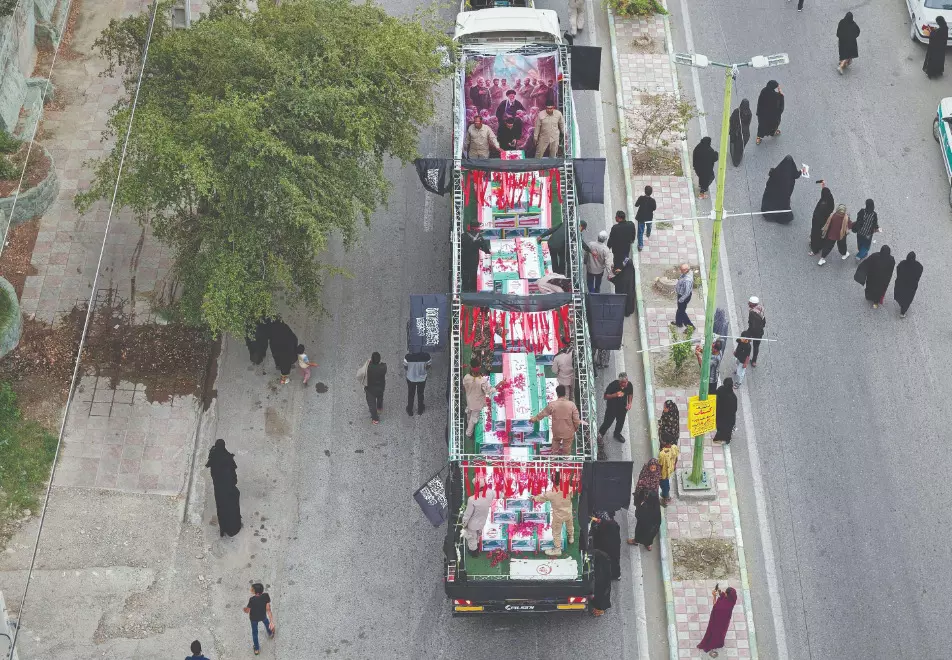


WASHINGTON/ DUBAI/ MOSCOW: On the fourth day of a joint US-Israel attack on Iran which triggered retaliatory strikes and brought the Middle East to the brink of full fledged war, U.S. President Donald Trump on Tuesday claimed Iran’s Air Force and Navy had been destroyed and its leadership structure – starting with Supreme Leader Ayatollah Ali Khamenei – eliminated.
In a brief Truth Social post, in which the US President shared an opinion published by the Washington Post – ‘We’re witnessing the birth of the Trump doctrine’ – he crowed: “Their air defense, Air Force, Navy, and Leadership is gone. They want to talk. I said “Too Late!”
This comes following Trump’s earlier comments that the US has “the capability to go far longer” than its projected four-to-five-week time frame for its military operations against Iran.
US-Israel airstrikes have killed at least 787 people in Iran since the start of the war, the Iranian Red Crescent Society said Tuesday in a message on X.
Earlier, President Trump, suggested in an interview to New York Post that he was not ruling out the possibility of sending US military on ground and left open the Possibility for a more extensive US military operation.
US Defence Secretary Pete Hegseth in a press briefing on Monday had said that the Trump administration would not get into the “foolish” exercise of telegraphing “what we will or will not do.”
White House Press Secretary Karoline Leavitt announced that “49 of the most senior Iranian regime leaders” have been killed in the US-Israeli strikes on Tehran and declared that “killing terrorists is good for America”.
Meanwhile, Israeli and U.S. strikes hit the Tehran building of a body tasked with electing Iran’s new supreme leader, local media reported.
“The American-Zionist criminals attacked the Assembly of Experts building in Qom,” south of Tehran, according to the Tasnim news agency. Local media showed footage of the building severely damaged in the strikes.
As the conflict in the region intensifies, Trump said that the US has “the capability to go far longer” than its projected four-to-five-week time frame for its military operations against Iran.
Across Tehran, the sound of explosions rang out through the night and into the early morning hours on Tuesday, as the US and Israel have continued to pound Iran since killing its Supreme Leader Ayatollah Ali Khamenei on Saturday.
Tehran and its allies have hit back against Israel, neighbouring Gulf states, and targets critical to the world’s production of oil and natural gas. The intensity of the attacks and the lack of any apparent exit plan set the stage for a prolonged conflict with far-reaching consequences.
Israel and the US have given conflicting answers about what exactly the war’s objectives are or what the endgame might be.
Israeli Prime Minister Benjamin Netanyahu late Monday defended the decision to go to war, contending in an interview on Fox News that Iran was rebuilding “new sites, new places” that would make “their ballistic missile program and their atomic bomb program immune within months,” without providing evidence.
Satellite photos analysed by The Associated Press showed limited activity at two nuclear sites in Iran before the war, with analysts saying it was likely Tehran was trying to assess damage from American strikes in June and possibly salvage what remained there.
Call for putting an end to escalating violence and return to diplomacy was made by Turkish Foreign Minister Hakan Fidan.
“Our fundamental request and demand is clear: the mutual attacks must stop immediately, and diplomacy must resume,” Fidan said, according to a transcript of his remarks to journalists late Monday.
The Italian government said Tuesday it is working “non-stop” to assist Italian citizens stranded in the Middle East. Italy scheduled two flights, including one from Muscat, Oman, to Rome’s Fiumicino airport on Tuesday to carry around 300 people and another from Abu Dhabi to Milan to carry about 200 people, mostly young students.
Romanian tourists arrived in Bucharest early Tuesday after travelling from Israel to Cairo to escape the conflict.
Hundreds of Romanian Orthodox Church pilgrims were stranded in Israel while visiting Bethlehem on a trip led by Romanian priests when the war broke out. The group was forced to cut their trip short to return to Romania.
Meanwhile, reports from Moscow said that Russian President Vladimir Putin is making all possible efforts to de-escalate the crisis in the Gulf and is in close contact with the regional leaders as
Iran is retaliating with massive strikes on the US facilities and infrastructure on their territories.
“Putin will certainly make every effort to facilitate at least a minor easing of tensions. In this regard, we discussed with virtually all of our interlocutors yesterday,” the Kremlin spokesman Dmitry Peskov said.
“Taking advantage of the dialogue we maintain with the Iranian leadership, (President) Putin will convey his deep concern regarding the strikes on their infrastructure to our colleagues in Iran,” he added.
According to the Kremlin, Putin spoke by telephone with leaders of Bahrain, Qatar, the UAE, and Saudi Arabia.
In his telephonic conversation with Crown Prince and Chairman of the Council of Ministers of the Kingdom of Saudi Arabia, Mohammed bin Salman, Putin discussed the escalating situation in the region as a result of the American-Israeli armed aggression against Iran.
“Both sides expressed serious concern over the real risks of escalation of the conflict, which has already affected several Arab countries and is fraught with catastrophic consequences.
In this context, Vladimir Putin underscored the urgent need to resolve the current extremely dangerous situation through political and diplomatic means,” the Kremlin said.
Israel sent additional troops into southern Lebanon on Tuesday and ordered residents of more than 80 villages to evacuate as the Iran-backed Hezbollah militant group said it is ready for an open war, escalating the already volatile situation in the region.
The latest exchanges started after Hezbollah fired rockets and drones early Monday toward northern Israel. Israel retaliated with a wave of airstrikes that killed 52 people in Lebanon, including a Palestinian militant and a Hezbollah intelligence official in Beirut’s southern suburbs.
More than 150 people were wounded and tens of thousands displaced.
Hezbollah said on Tuesday it fired two salvos of rockets toward northern Israel while Israeli airstrikes overnight damaged a building housing Hezbollah’s TV and radio stations. Beirut’s southern suburbs were subjected to a series of strikes in the afternoon on Tuesday that came without warning, and the Israeli military later said it targeted Hezbollah officials.
The Israeli military’s Arabic spokesman, Avichay Adraee, issued a warning for residents of more than 80 villages and towns asking them to leave, adding that people should not return to these areas until further notice.
A senior Hezbollah official said that after more than a year of abiding by a ceasefire as Israel’s strikes continued on Lebanon, the group’s patience has ended, leaving it with no option “but to return to resistance” and fight an open war with Israel.
“The Zionist enemy wanted an open war, which it has not stopped since the ceasefire agreement,” Mohamoud Komati said “So let it be an open war.”
Lebanese President Joseph Aoun told the ambassadors of Saudi Arabia, Qatar, the US, France and Egypt that Hezbollah has been firing rockets from areas north of the Litani River.
The Lebanese government says it has disarmed Hezbollah south of the river, along the border with Israel, and Lebanese troops are in full control of the area between the river and the border.
The UN peacekeeping force in southern Lebanon, known as UNIFIL, said its peacekeepers observed Israeli forces crossing into Lebanon in several areas “before returning south of the Blue Line,” referring to the border between the two countries.
Israel launched a ground invasion of Lebanon in October 2024 during its last war with Hezbollah.
It withdrew from most of southern Lebanon after a US-brokered ceasefire halted the fighting in November 2024, but has continued to
occupy five points on the Lebanese side of the border since then. with agency reports