Cold wave tightens grip across north India
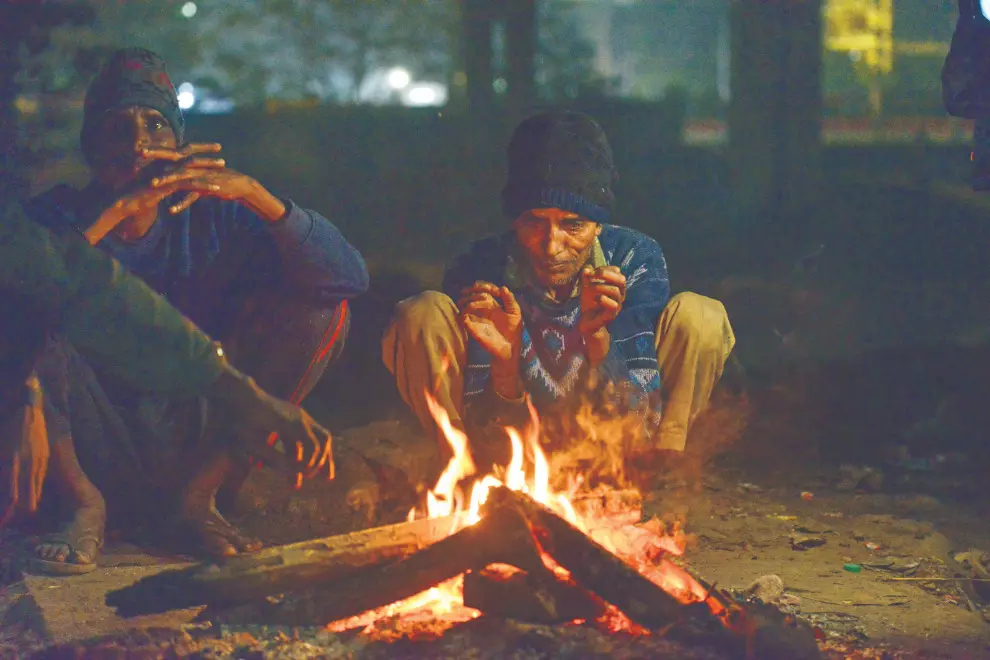


New Delhi: As dense fog blanketed large swathes of north India and icy winds swept across open fields and urban sprawls, the region reeled under its coldest conditions of the season, with several locations recording near-freezing or sub-zero minimum temperatures and the India Meteorological Department (IMD) warning that extreme cold and fog are likely to persist for the next few days.
In Haryana’s Gurugram and Punjab’s Bathinda, temperatures dropped to 0.6 degrees Celsius, while Fatehpur in Rajasthan’s Sikar district slipped below the freezing point, recording minus 0.4 degrees Celsius, local meteorological officials said on Monday. In parts of Rajasthan, the chill was even sharper, with Pratapgarh reporting a low of minus 2 degrees Celsius and Barmer minus 1 degree Celsius, according to the state weather office.
The cold was accompanied by frost across parts of the National Capital Region (NCR). Faridabad and Rewari reported near sub-zero conditions, and residents in Gurugram woke up to ground frost, brittle grass and a visible layer of ice on vehicle windshields. Officials noted that Gurugram had recorded a low of 0 degrees Celsius on January 11, 1971, though they said it could not be confirmed whether the latest minimum was the city’s all-time low due to gaps in historical data.
In Delhi, the cold wave tightened further, with the city registering its coldest January day since 2023 and recording a second consecutive day of cold wave conditions. The minimum temperature in the national capital settled at 3.2 degrees Celsius, plunging 4.2 notches below the seasonal average. The maximum temperature on Monday was 20.6 degrees Celsius, marginally above normal by 0.7 notch.
On Sunday, Delhi experienced its first cold wave of the season, with minimum temperatures dipping below 3 degrees Celsius in parts of the city. Ayanagar was the coldest at 2.9 degrees Celsius, while Palam station recorded 3.0 degrees Celsius, its lowest minimum in 13 years. The Safdarjung Observatory, Delhi’s principal weather station, logged a minimum of 4.8 degrees Celsius, 2.6 notches below average, while the maximum stood at 18.8 degrees Celsius, 1.1 notches below normal, IMD data showed. The IMD issued a yellow alert for similar conditions over the next two days. Delhi’s air quality remained “poor”, with a 24-hour average Air Quality Index (AQI) of 291, Central Pollution Control Board (CPCB) data showed.
The IMD forecast mainly clear skies for Delhi, with moderate fog at many locations and dense fog at isolated spots during morning hours. The minimum and maximum temperatures are expected to be around 4 degrees Celsius and 20 degrees Celsius on Tuesday.
In Rajasthan, intense cold continued to disrupt daily routines, keeping many residents indoors. The weather department said night temperatures remained below 8 degrees Celsius in many areas, with isolated pockets witnessing severe cold wave conditions. After Fatehpur, Lunkaransar in Bikaner (0.4 degrees Celsius) and Churu (1.3 degrees Celsius) were among the coldest places recorded in the state, while Ganganagar and Karauli logged minimums of 1.4 degrees Celsius and 1.5 degrees Celsius respectively. Other stations reported Pilani at 1.2 degrees Celsius, Sikar 1.7 degrees Celsius, and Jhunjhunu 1.9 degrees Celsius. Jaipur recorded 9.2 degrees Celsius. Fog also reduced visibility, with dense to very dense fog in parts of eastern Rajasthan and dense fog in the west, slowing traffic during early hours.
Punjab, Haryana and their common capital Chandigarh also remained under severe cold. Fog reduced visibility in several pockets. Chandigarh recorded minimum temperatures between 3.3 degrees Celsius and 5 degrees Celsius. Bathinda was among the coldest spots in Punjab, while Hisar was among the coldest in Haryana. “Intense cold weather is likely to continue in Punjab and Haryana over the next three days. After this, the cold weather conditions will prevail, but severe cold is likely to abate,” Chandigarh Meteorological Department Director Surender Paul said.
Residents across the region described unusual severity. “During severe winters, minimum temperatures do dip in Gurugram. However, I do not recall the mercury dropping close to the sub-zero level in the past many years,” said Vinod Kumar, a local.
The freezing conditions also affected agriculture. Devi Ram, a farmer from Haryana’s Binola village, said frost blanketed crops early Monday. “When I went to the fields early this morning, it felt like a white sheet had been spread over the crops,” he said, adding that while frost benefits wheat, vegetable crops could suffer losses. Agricultural scientist Dr Anand Kumar advised farmers to undertake light irrigation to protect mustard and other crops from frost damage.
In Kashmir, a slight respite was reported as minimum temperatures rose by a couple of degrees, though they stayed below freezing during the ongoing “Chilla-i-Kalan”, the 40-day harsh winter phase. Srinagar recorded minus 2.4 degrees Celsius on Sunday night, up from minus 5.2 degrees Celsius the previous night, while Pulwama logged minus 6.5 degrees Celsius. Shopian was colder at minus 8.6 degrees Celsius, and Pahalgam recorded minus 7.6 degrees Celsius. Sub-zero temperatures caused partial freezing of Dal Lake and other water bodies.
Elsewhere, Himachal Pradesh’s meteorological centre predicted light rain and snow at isolated places in the high hills from January 16 to 18 as a fresh western disturbance is likely to affect the western Himalayan region from January 15. A yellow warning was issued for cold wave in isolated areas of Chamba till Wednesday and for dense fog in seven districts till January 15.
Cold conditions were also reported in Uttar Pradesh, where day temperatures ranged between 13 degrees Celsius and 19 degrees Celsius in several cities, and in Jharkhand, where Gumla recorded 2.8 degrees Celsius and authorities ordered school closures and revised timings amid IMD’s yellow alert for January 13-16.