Centre’s delimitation push, 850-seat LS aim to pave way for women’s quota by 2029
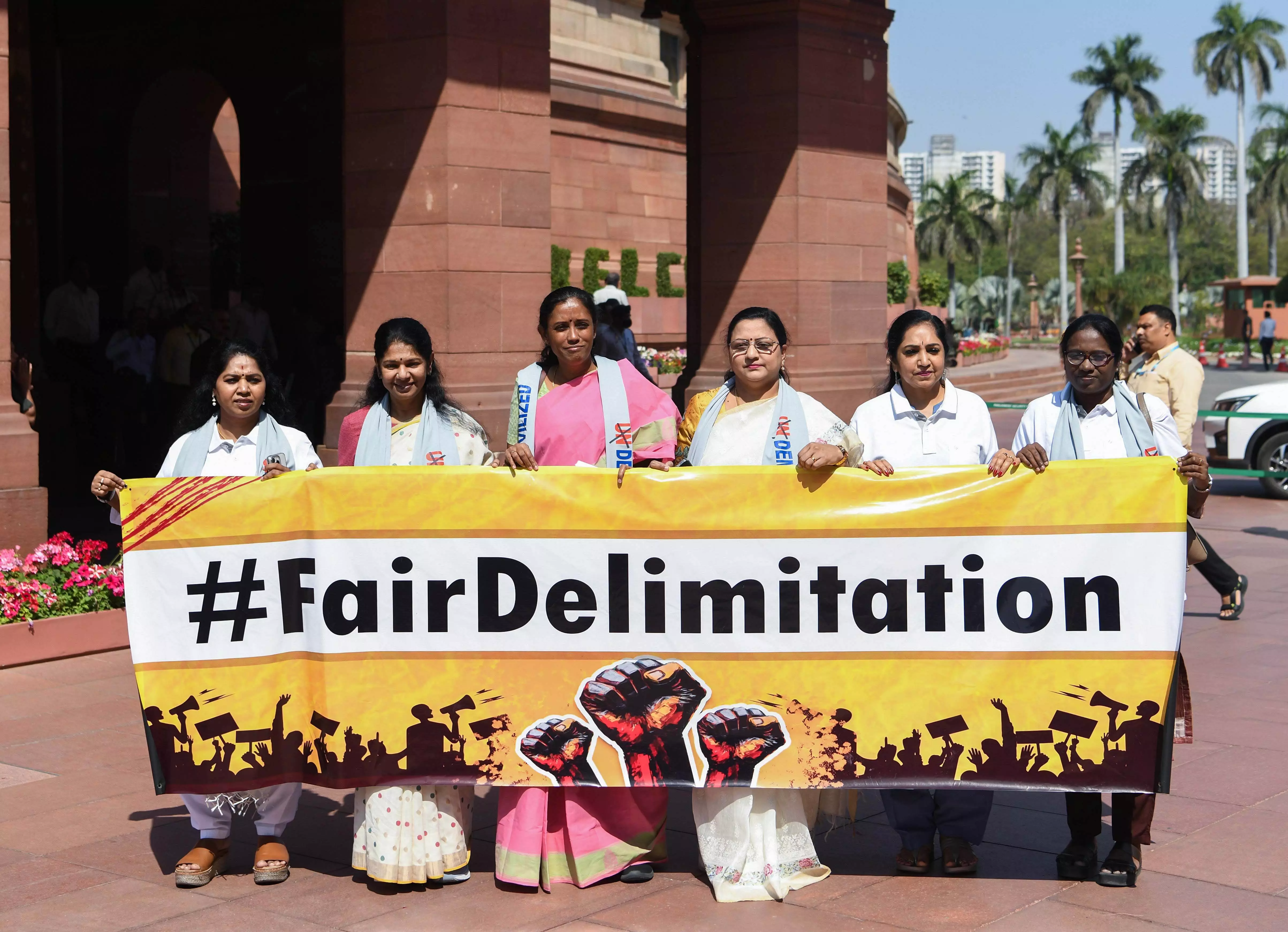


NEW DELHI: The BJP-led Central government has set the stage for a sweeping electoral overhaul, with the proposed Delimitation Bill, 2026 emerging as the linchpin of its plan to redraw parliamentary and Assembly constituencies based on the latest census, even as it faces sharp Opposition pushback over timing and representation. To be introduced during a special sitting of Parliament from April 16–18, the Bill will replace the 2002 law and empower the government to constitute a Delimitation Commission to reallocate seats, a step crucial for operationalising women’s reservation by 2029.
It is being advanced alongside the Constitution (One Hundred and Thirty-First Amendment) Bill, 2026, which seeks to expand the Lok Sabha from 543 to 850 seats and revise population norms for representation and presidential elections, and the Union Territories Laws (Amendment) Bill, 2026, aimed at recalibrating governance frameworks in Delhi, Jammu and Kashmir, and other UTs, together marking a significant push to restructure India’s representative architecture.
The government has circulated the Bills among Members of Parliament in an exercise aimed at operationalising the women’s reservation law by 2029 elections.
The central government has proposed an increase in the number of Lok Sabha seats up to 850 as part of the efforts to implement women’s reservation in the House from the 2029 polls. According to the Bill, 815 seats are proposed for the states and 35 for the Union Territories.
The government is proposing to increase the number of Lok Sabha seats from 543 to 850 by revising Article 81. It also says the population for seat allocation will be based on data from the latest census, as decided by Parliament.
The government plans to move a Constitution amendment Bill for the implementation of 33 per cent reservation for women in the Lok Sabha from 2029 in a special sitting of Parliament on April 16-18.
This special part of the budget session has been convened to amend provisions of Nari Shakti Vandan Adhiniyam, 2023, and a proposed Delimitation Bill. While the Nari Shakti Vandan Adhiniyam was passed in 2023, the reservation was to take effect only after a delimitation exercise and the ongoing census, but now it can be linked to a census from the past, being 2011 in this case.
The Union Territories Laws (Amendment) Bill, 2026 proposes changes to three key legislations: the Government of Union Territories Act, 1963, the Government of National Capital Territory of Delhi Act, 1991, and the Jammu and Kashmir Reorganisation Act, 2019. Through amendments to these laws, the Bill seeks to refine administrative and governance frameworks in Union Territories. The move comes in response to evolving governance dynamics, particularly in Delhi and Jammu and Kashmir, necessitating updates to existing legal structures.
Another legislative step in this direction is the Constitution (One Hundred and Thirty-first Amendment) Bill, 2026, which proposes changes to Article 55. The Bill seeks to revise the Explanation concerning the term “population” used in the election of the President. It aims to base this definition on the latest census, while empowering Parliament to frame principles ensuring uniformity, equitable representation, and federal balance. It also allows for the continued use of existing population figures until updated data is officially notified.
Earlier, Prime Minister Narendra Modi called out to all political parties to support “collective action” to ensure that the reservation is in place by 2029. “From the 16th of April, a historic discussion related to the Nari Shakti Vandan Adhiniyam is set to take place in Parliament,” Modi wrote.
“Let all political parties come together and advance this work concerning the rights of the country’s sisters and daughters with a unanimous consensus,” the Prime Minister said at a public meeting in Dehradun on Tuesday. Meanwhile, opposition parties have expressed their concerns about the proposed delimitation Bill, alleging that it will limit the representation of the southern states in the Lok Sabha.
Opposition parties have also objected to the government’s “rushing” of the Bill before the general census.
Alleging that the centre is ‘bulldozing’ the constitutional amendment, Tamil Nadu Chief Minister MK Stalin said that the amendment is being passed without proper consultation with states. He said Tamil Nadu would launch a massive agitation if the state’s interests are harmed or if southern states are disproportionately affected.
Congress leader Sonia Gandhi alleged that the real issue is not women’s reservation at all, but rather the delimitation exercise being bundled with it.
Several of the provisions of the new delimitation Bill are similar to the 2002 law, which would be repealed. According to the draft Delimitation Bill, 2026, the Delimitation Commission “shall comprise of the following members, namely: one member, who shall be a person who is or has been a Judge of the Supreme Court, to be appointed by the Central Government, as the Chairperson of the Commission; the Chief Election Commissioner or an Election Commissioner nominated by the Chief Election Commissioner, ex officio’ and the State Election Commissioner of the State concerned, ex officio.”
The Central government may, by notification, specify the term of the Commission, the Bill says. On the request of the Commission, the government may extend the term by such further period as it may consider necessary, it says.
“The Election Commission shall act as Delimitation Commission for the purpose of delimiting constituencies in the Legislative Assembly of the Union Territory of Jammu and Kashmir falling under the occupation of Pakistan, when the area of the Union Territory of Jammu and Kashmir under the occupation of Pakistan ceases to be so occupied,” the Bill says.
“It shall be the duty of the Commission to readjust, on the basis of the latest census figures, the allocation of seats in the House of the People to the States and Union territories, the total number of seats in the Legislative Assembly of each state and the division of each state and Union territories into territorial constituencies for the purpose of elections to the House of the People and to the Legislative Assembly,” the draft law says.
The draft law states every Assembly constituency shall be so delimited as to fall wholly within one Parliamentary constituency.
The Opposition is gearing up to challenge the government’s delimitation push, particularly the use of 2011 Census data. Parties including AAP, RJD and DMK are likely to argue that the exercise should instead be based on updated 2021 Census figures.
Trinamool Congress MP Derek O’Brien questioned the government’s intent, arguing that the proposed amendments are more focused on delimitation than on implementing women’s reservation.
He noted that the BJP would need Opposition support to pass constitutional amendments, which require a two-thirds majority in Parliament.