Can decide citizenship for registration as voters, not to deport or check visa: EC to SC
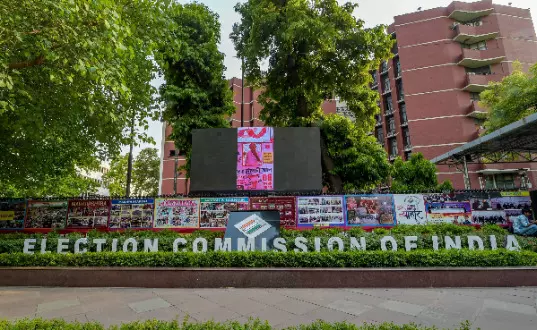


New Delhi: The Election Commission on Thursday told the Supreme Court that it could determine citizenship only to the extent of registration as a voter and could not deport anyone or decide if a person has a visa to stay in India.
Vehement submissions to this effect were made by senior advocate Rakesh Dwivedi on behalf of the poll panel before a bench of Chief Justice Surya Kant and Justice Joymalya Bagchi.
The bench resumed final hearings on a batch of petitions that challenged the EC's SIR exercise in several states, including Bihar, raising constitutional questions on the scope of the poll panel's powers, citizenship, and the right to vote.
At the outset of the proceedings, Dwivedi referred to Article 326 of the Constitution to support the decision of the EC to undertake special intensive revision (SIR) of electoral rolls and said it provides for elections based on adult suffrage.
He submitted that adult suffrage, in its constitutional sense, consists of three distinct elements, all of which must be satisfied at the stage of registration.
"Unless these three conditions are satisfied, one will not be entitled to be registered as a voter," Dwivedi argued, adding that if a person is found, upon proper reasoning, not to be a citizen and is still included in the rolls, it would "go against the grain of the Constitution."
The lawyer relied on Section 16 of the Representation of the People Act, 1950, to contend that Parliament has made it explicit that only citizens are entitled to be registered as electors.
Advocate Prashant Bhushan, appearing for petitioner NGO Association for Democratic Reforms (ADR), said while there was no dispute that citizenship is a prerequisite for voting, the core question was whether the poll panel has the authority to determine citizenship at all.
The CJI said the commission's stand was that it was only identifying citizens, not adjudicating citizenship in a broader sense.
Dwivedi said the EC's role is limited and "it can determine citizenship only to the extent of registration as a voter … We cannot deport anyone or decide whether a person has a visa to stay in India. Those issues are not our concern."
The bench said that while the poll panel cannot act as the authority to grant citizenship, it can hold an inquiry to verify whether a person claiming to be a citizen is genuine for electoral purposes.
Dwivedi said the poll panel was adopting a liberal approach by accepting entries from the 2003 electoral rolls as a baseline, and the persons whose parents were present in the rolls before 2003 were being accepted, and those born between 1985 and 1986, who were eligible to vote in 2003, were included in the SIR.
Referring to a judgement, the bench said that the petitioners argued that if a person's name appeared in any electoral roll, there should be a presumption of citizenship.
Dwivedi said he would respond to that argument separately.
Bhushan referred to the EC's 2003 guidelines, which, according to him, stated that it was not the job of the Electoral Registration Officer (ERO) or the EC to determine citizenship, but only to flag issues.
Justice Bagchi, however, said that the poll panel has a constitutional duty to ensure that non-citizens do not figure in the electoral rolls.
Addressing allegations that the SIR was designed to cause large-scale disenfranchisement, Dwivedi said that out of nearly 65 lakh voters, no individual had approached the Supreme Court or a high court claiming wrongful exclusion.
"Only organisations like ADR, PUCL and some parliamentarians are before this court," he said.
He argued that preparation of electoral rolls under Article 326 inevitably involves exclusions, such as in cases of death, duplication, or migration.
"Why do the petitioners want dead people to be on the voter list?" he asked.
Dwivedi said the identity of a person in terms of caste or religion was irrelevant to the exercise. "Only citizenship is to be seen," he said.
On the question of burden of proof, he said it was for individuals to produce documents when asked.
Drawing an analogy, he said that when entering the Supreme Court or an airport, one cannot refuse to show identification. "Today, we lay great emphasis on rights, but no emphasis on duty. Rights and duties are intertwined," he said.
Dwivedi also questioned the role of political parties, saying that they were directly concerned with elections and should be assisting voters on the ground with documentation.
These organisations and political parties should ponder over the fact that only 67 per cent voted in the Bihar Assembly Polls, and they should work to make democracy work better by asking people to vote, he said.
Justice Bagchi said awareness of civil rights is often not proportional to economic prosperity, while the Chief Justice, in a lighter moment, remarked that "by the next elections, we will not be surprised if there is online voting."
The hearing remained inconclusive and would resume on January 20 at 2 pm.
On January 13, the poll panel said that it functions as the original authority in matters relating to electoral rolls and conduct of polls, and its opinion is binding on the President if a person acquires citizenship of another country.