
BMC: Numbers clear, game unclear
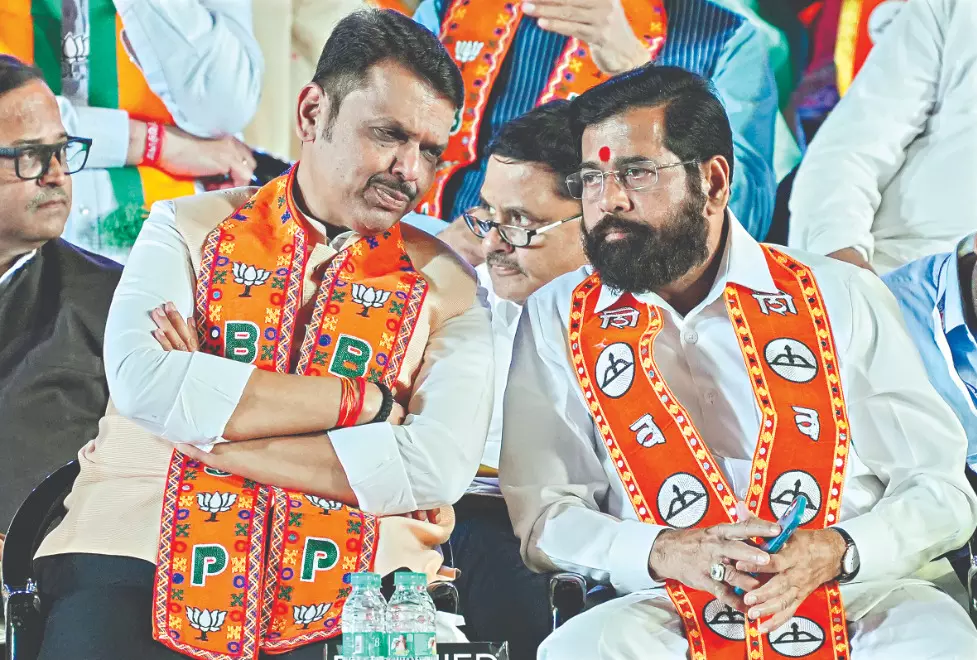


MUMBAI: Though the BJP-Eknath Shinde-led Shiv Sena alliance won a clear majority in the 227-member Brihanmumbai Municipal Corporation (BMC) and enjoys a numerical edge, power sharing equation remains to be sorted out, giving rise to speculation that a churn is far from over and the game of nerves is on.
Giving another dimension to the prevailing uncertainty and suspense over the all important post of Mayor, the Shinde faction has moved all its 29 newly elected corporators into a five-star hotel in Bandra, signaling that resort politics is back.
In the recent civic polls, the BJP and Shinde-led Shiv Sena Mahayuti alliance secured 89 and 29 seats respectively. Shiv Sena (UBT) won 65 seats, while its ally MNS could win six.
With the mayoral vote ahead and margins slim, ally Shiv Sena is guarding its corporators amid fears of last-minute churn and poaching. The BMC elections are held every five years to elect corporators, who represent their respective wards in the civic house. To form a majority and elect the mayor of Mumbai, a party or alliance needs at least 114 seats. The ruling alliance’s tally stands at 118 – just four seats above the halfway mark. With margins this narrow, even a small shift could complicate control of the civic house.
Once the majority is secured, the ruling side decides who will occupy the mayor’s chair. The process mirrors how the prime minister or chief ministers are chosen – elected representatives pick their leader from among themselves.
The mayor’s election is governed by a separate legal process that begins only after the new House is formally constituted. Unlike ward results, which are decided directly by voters, the mayor is elected by corporators, and the post is subject to reservation by rotation. Until this reservation is decided through a draw of lots and officially notified, political parties cannot name their candidates, making it unlikely that Mumbai will get a mayor this week.
Under the law for most Urban Local Bodies across the country, the mayor’s post must be reserved by rotation for Scheduled Castes, Scheduled Tribes, Other Backward Classes and women. This reservation is not fixed in advance. Instead, it is decided through a draw of lots conducted by the Urban Development Department. Only after this lottery is held and the category is officially announced can the process of electing the mayor begin.
The process ensures that the mayor’s post rotates among SC,ST,OBC and women categories and the lottery system is in place to keep the process neutral and unbiased and also to ensure that one category does not benefit repeatedly. The last two mayors of Mumbai as per the reservation lottery were from the open general category.
On the other hand, earlier in the day, Uddhav Thackeray said the BJP failed to finish off his party which had ruled the BMC for 25 years.
“It’s my dream to install a Shiv Sena (UBT) mayor in Mumbai, and if God is willing, this dream will be realised,” he said, interacting with party workers.
Asked about reports about Shinde-led Sena’s corporators moving to a hotel, Thackeray said they were afraid of the BJP. “Those who had once abandoned a party can do it again,” he said, referring to the Shinde faction breaking away from the undivided Shiv Sena in June 2022.
Reacting to Thackeray’s statement about his party getting the Mayor’s post, Chief Minister Devendra Fadnavis jocularly asked whether by ‘Deva’ his former ally was referring to him or the “God above”. “I am also called ‘Deva’, hence I am asking,” Fadnavis said, drawing laughter from his supporters.
Shiv Sena (UBT) MP Sanjay Raut said the opposition has a sizable number of corporators. “We can topple them from the chair anytime, but we respect democracy,” he said.
The Congress, which had tied up with Vanchit Bahujan Aghadi (VBA), bagged 24. AIMIM won 8, NCP 3, Samajwadi Party 2, and NCP (SP) got just one seat.
Raut claimed that many newly elected Shiv Sena corporators, who originally belonged to the Bal Thackery-founded party before its division, do not want a BJP mayor in Mumbai.
When asked whether there will be a “ghar wapsi” (return) of corporators, Raut said, “Many new corporators are originally Shiv Sainiks (of undivided Shiv Sena). Our understanding is that everyone wants a BJP mayor not to be elected.”
Analysts say the verdict in polls to 29 municipal corporations in Maharashtra is expected to redraw equations within the opposition bloc since the Sharad Pawar-led NCP (SP) has been decimated in its stronghold in Pune, Uddhav Thackeray’s Shiv Sena (UBT) has put up a fight in its home turf in Mumbai while seeing its base shrink in others and the Congress has gained ground in several cities.
According to the final tally, the BJP won 1,425 out of a total 2,869 seats across 29 municipal corporations, Eknath Shinde’s Shiv Sena 399, Congress 324, Ajit Pawar-led NCP 167, Shiv Sena (UBT) 155, NCP (SP) 36, MNS 13, BSP 6, parties registered with the SEC 129, unrecognised parties 196, and 19 independents.
With the Congress coming third overall and having done much better than Shiv Sena (UBT) and NCP (SP), its allies in Maha Vikas Aghadi, political analysts said it will force a rethink as far as coordination, seat-sharing and leadership are concerned ahead of the 2029 assembly polls.
While Shiv Sena (UBT) lost its crown jewel, the BMC, and the NCP (SP) saw its bastions in Pune and Pimpri-Chinchwad crumble despite allying with Ajit Pawar’s NCP, the Congress managed to be the single largest party in Kolhapur, Chandrapur and Bhiwandi.
Congress sources said the party will now demand a larger share in the MVA pie claiming the “regional pride” card of Thackeray and Pawar had failed to arrest BJP’s growth.
While Thackeray’s party has managed to remain the main challenger for BJP in Mumbai, its influence in other parts of the state has shrunk, which would directly affect its claim to be senior partner in the MVA based on its organisational muscle, analysts said.
The results indicate vote division between Shiv Sena (UBT) and Shiv Sena has benefited the ruling alliance in several wards, they pointed out. While Thackeray’s party retains emotional connect and brand recall, translating this into ward-level victories remains a challenge in the absence of a unified organisational machinery, these analysts said.
The NCP (SP) has been the worst affected since the decimation in Pune district and single digit seats in most urban areas means its claim of being the “architect” of the MVA is now up for debate.
Senior Congress leader Ratnakar Mahajan said his party had emerged as the largest party in the opposition bloc but admitted the results in recent local body and civic polls showed the gap between the winners and the opposition is wide.
With Agency Inputs



