B’desh PM Hasina secures 4th straight term as her party wins election without Oppn
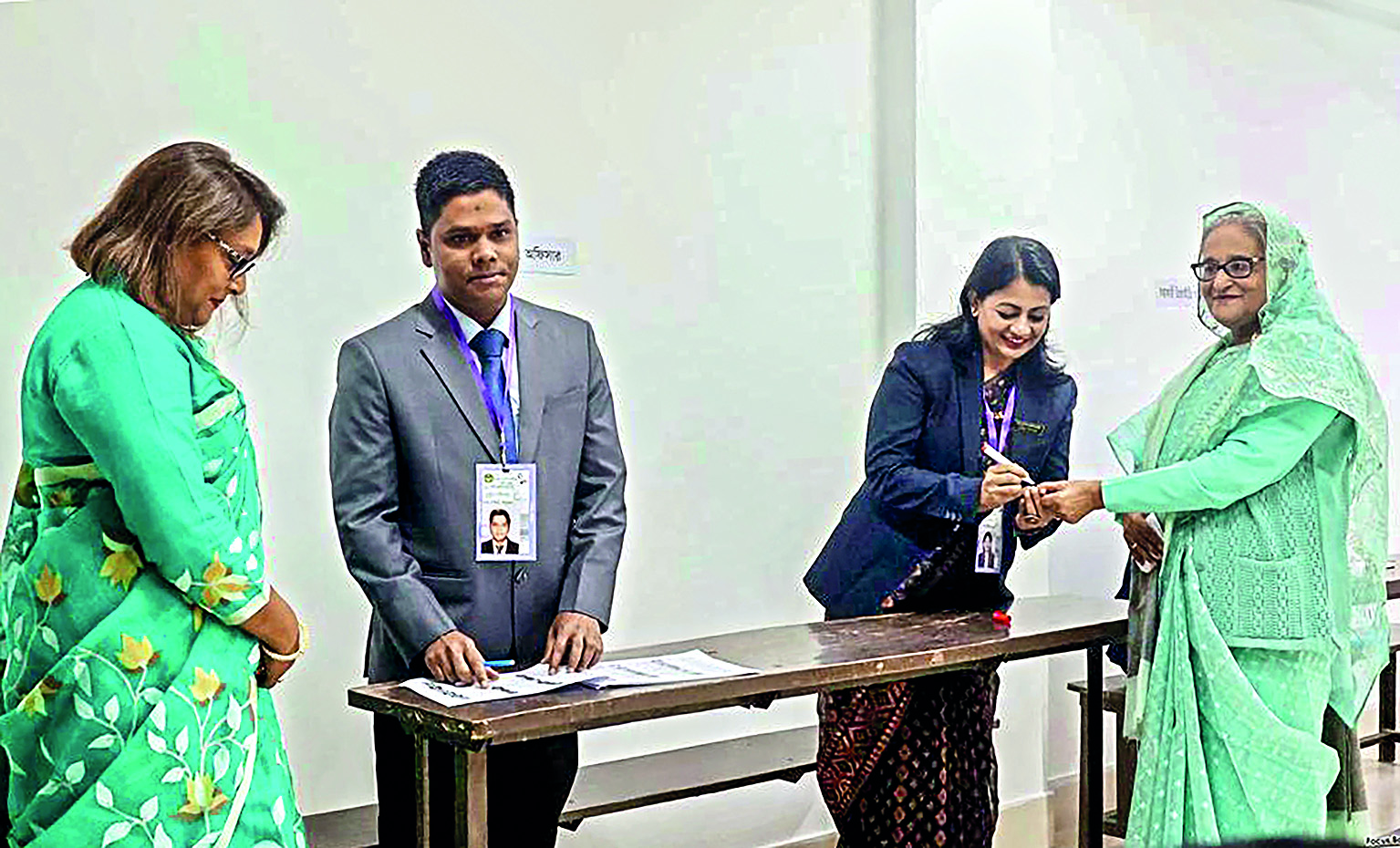


Dhaka: Bangladesh witnessed a historic yet controversial election on Sunday, as Prime Minister Sheikh Hasina secured a landmark fourth term in office. Her Awami League party swept the polls, winning a massive two-thirds majority with 200 seats in the 300-member parliament. While voting largely concluded on Sunday, counting is still underway for some constituencies, but the Awami League’s victory is already assured.
Hasina has now served as Prime Minister for a total of 17 years, spread across four separate terms. However, the elections themselves were not without problems. Sporadic outbreaks of violence marred the Bangladesh’s 12th general election, and the main opposition Bangladesh Nationalist Party (BNP) and its allies chose to boycott the polls, alleging irregularities and a lack of fair play.
The voter turnout was significantly lower than usual, likely influenced by the boycott call issued by the BNP led by the ailing former Prime Minister Khaleda Zia. Khaleda Zia, 78, is under house arrest as a convict of graft charges. The BNP had also boycotted the 2014 election but joined the one in 2018. The BNP claimed that a free and fair election was impossible under the current government.
They urged voters to stay away from the polls, calling it a “farce” and a “sham democracy.” This led to a subdued atmosphere across the country, with polling stations witnessing minimal queues and a lack of the usual election day enthusiasm.
Notably, the ruling party allowed several party members to contest as “independent” candidates, leading to multiple AL candidates competing in some constituencies. While 27 parties contested the polls, including the Opposition Jatiya Party (JAPA), many were smaller parties aligned with the ruling AL, often referred to as “satellite parties.” The BNP’s boycott was accompanied by a 48-hour nationwide strike, reflecting its deep dissatisfaction with the current government. The Opposition’s allegations of pre-election arrests by the AL government also contributed to a lack of enthusiasm among voters. Around 25,000 Opposition cadres including the BNP’s entire local leadership were arrested in the ensuing crackdown, the party says. The government puts the figure at 11,000.
With roughly 119.6 million registered voters, over 42,000 polling stations across the country saw more than 1,500 candidates from 27 political parties and 436 independent hopefuls vying for seats.
Adding to the political tension, the elections were held under tight security, with over 7.5 lakh law enforcement and security personnel deployed to maintain order.
Over 100 foreign observers, including three from India, monitored the process to ensure its fairness and credibility.
While scattered incidents of violence marred the voting process in some areas, elections in Bangladesh proceeded largely peacefully across 299 of the 300 constituencies on Sunday. Polling was suspended in one seat due to a candidate’s death.
In a notable incident, the Election Commission disqualified a ruling Awami League candidate in Chattogram for “scolding and threatening” a police officer during the final hours of voting.
This left the constituency to be contested by two independent candidates, both of whom are also affiliated with the ruling party.
Polling stations saw fewer voters than usual, with only supporters of the ruling party and election officials present in significant numbers. Casting votes proceeded smoothly in most areas, thanks to the lack of long queues and idle presiding officers.
Voting was cancelled at three centers, and shots were fired during a clash between supporters in Chattogram, injuring two individuals. Clashes between supporters of different candidates in Jamalpur and Dhaka also resulted in injuries. The Election Commission has taken action in response to these incidents, including ordering the arrest of the Industries Minister’s son on charges of electoral fraud in Narsingdi.
Prime Minister Sheikh Hasina of Bangladesh cast her vote at Dhaka City College polling center on Sunday, marking the start of the country’s general elections. Her daughter, Saima Wazed, accompanied her.
Hasina, 76, has served as Prime Minister since 2009 and her Awami League party secured victory in the last election held in December 2018.
Speaking to reporters after voting, Hasina expressed optimism about the democratic process and encouraged all citizens to participate. “People will vote as they wish, and we have ensured a safe and secure environment for them to do so,” she said.
Responding to questions about the opposition Bangladesh Nationalist Party (BNP) boycotting the election, Hasina maintained that her responsibility lies with the people of Bangladesh. “Whether others accept this election or not is irrelevant to me,” she stated. “My focus is on fulfilling the needs and aspirations of the Bangladeshi people.”
She also addressed concerns about violence and instability, attributing them to the actions of the BNP-Jamaat alliance. “They have engaged in disruptive tactics, including arson attacks, which undermine the democratic process,” she said.
She also expressed gratitude towards India, calling it a “trusted friend” and acknowledging its crucial support during Bangladesh’s Liberation War and in the wake of the 1975 military coup. In August 1975, Sheikh Mujibur Rahman, his wife and their three sons were assassinated in their home by military officers. His daughters Hasina and Rehana survived the purge as they were abroad.