
Another familiar script
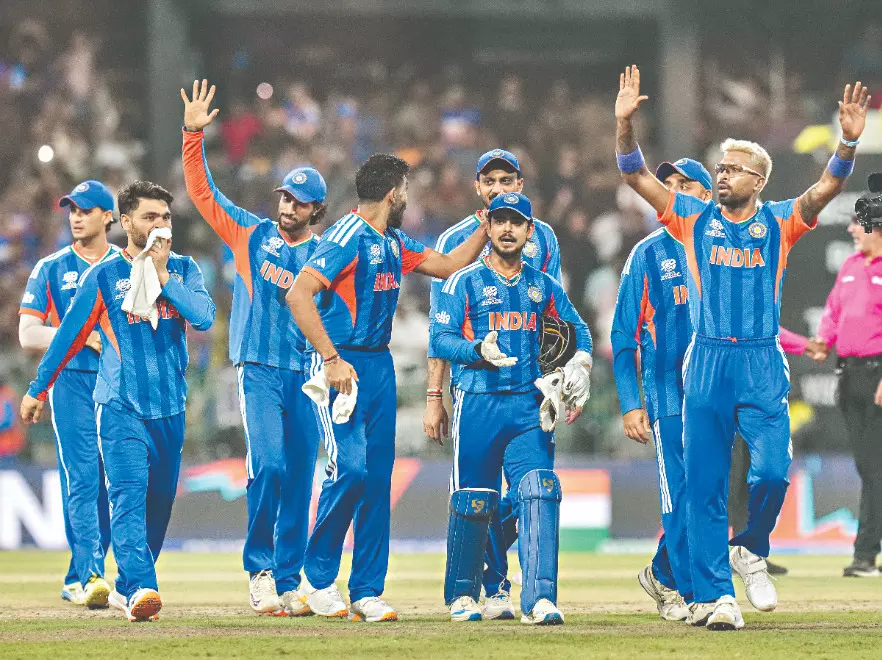


Colombo: The biggest match of this World Cup did not simply arrive; it loomed heavy with memory, politics and the familiar ache of rivalry. When it finally passed at R Premadasa Stadium, it left behind a result that now feels almost ritual. India had won again, extending their dominance to eight victories in nine World Cup meetings and sealing a one-sided 61-run triumph that sent them into the Super Eight stage of the T20 World Cup.
India’s 176 for 7 was, in cricketing terms, a par-plus total on a surface that gripped and held for spin. But in emotional terms, it was more than enough, because India’s strength in this rivalry now lies not just in runs scored but in control asserted.
After Pakistan asked India to bat, the start was unusual. Captain Salman Ali Agha brought himself on in the opening over, and Abhishek Sharma fell trying to lift him over the infield, only to find Shaheen Shah Afridi at the edge of the circle. Off spin continued through Saim Ayub in the power play, and Pakistan briefly found control. But for the next eight overs, the evening belonged to Ishan Kishan.
Kishan’s incandescent 77 off 40 balls stood out for both daring and difficulty. His half-century came from just 27 deliveries, setting both tempo and tone of the innings. He played with a freedom that refused to acknowledge the noise around him, as though the occasion belonged to his bat alone.
Kishan shared an 87-run stand for the second wicket with Tilak Varma, whose own contribution was modest but stabilising. Kishan eventually fell attempting to manufacture room against Ayub, missing the ball completely. Even when Pakistan’s spinners dragged India back through the middle overs, the platform he laid ensured the innings never fell away completely.
His dismissal opened a brief window for Pakistan. Ayub removed Tilak and Hardik Pandya off successive deliveries, and India slipped from 126 for two to 126 for four in the 15th over. Suryakumar Yadav and Shivam Dube could not fully accelerate but added a crucial 33 runs, nudging India beyond 150. A late surge followed as Dube and Rinku Singh took 15 runs off Afridi in the final over, pushing the total into the 170s and restoring the sense of command Kishan had established earlier.
That control translated directly into India’s bowling, the phase in which this team now holds its most decisive edge. The modern Indian attack is neither purely pace-driven nor spin-reliant; it is layered, disciplined and tactically alert. Jasprit Bumrah and Hardik Pandya set the standard with unrelenting accuracy and subtle variation, in stark contrast to Shaheen Afridi, who searched for swing and never quite found his rhythm. India did not hunt magic deliveries; they built pressure, ball by ball, until Pakistan were forced into strokes they did not truly believe in.
The decisive passage came early. At 34 for 4, with Babar Azam bowled by Axar Patel, Pakistan’s chase had already tilted beyond recovery. From there, the chase never truly took shape. The numbers were stark — the required rate climbing, win probability collapsing — but more telling was the body language. Pakistan were not building a pursuit; they were surviving one. Hardik Pandya, Jasprit Bumrah, Axar Patel, and Varun Chakravarthy dismantled the Pakistan lineup by taking two wickets each. To round out the clinical bowling performance, Kuldeep Yadav and Tilak Varma also chipped in with one wicket apiece.
Earlier in the evening Pakistan’s spinners had been disciplined and effective in squeezing India. Yet in this contest, fragments of promise were never enough.
What the match ultimately exposed, once again, is the widening difference in cricketing culture between the sides. India operate with depth, structure and emotional steadiness. Pakistan, for all their talent, too often appear caught between expectation and uncertainty, a team that loses its way in the mind before it can recover in the middle. The journey from their old identity—fierce, volatile and capable of brilliance—to this more hesitant version has been shaped as much by instability off the field as inconsistency on it.
India, by contrast, looked assured even when briefly challenged. When the middle overs slowed, there was no panic. When the finishing overs did not explode, there was no visible anxiety. With the ball they hunted as a unit: Axar’s incisive strikes, Kuldeep Yadav’s control, the catching sharp and certain under lights. Pakistan’s innings unravelled accordingly, the asking rate spiralling until the end felt inevitable rather than dramatic.
So India move on, 8–1 against Pakistan in World Cups, the statistic now less a quirk and more a marker of an era defined by superiority in skill, clarity and conviction. Pakistan remain a team of talent searching for structure, of promise seeking belief. The rivalry endures in the stands and in the imagination, but on the field India have made it something else entirely — a contest they now know, almost instinctively, how to win.



