Amid global uncertainty, India witnessing unprecedented certainty, says PM Modi
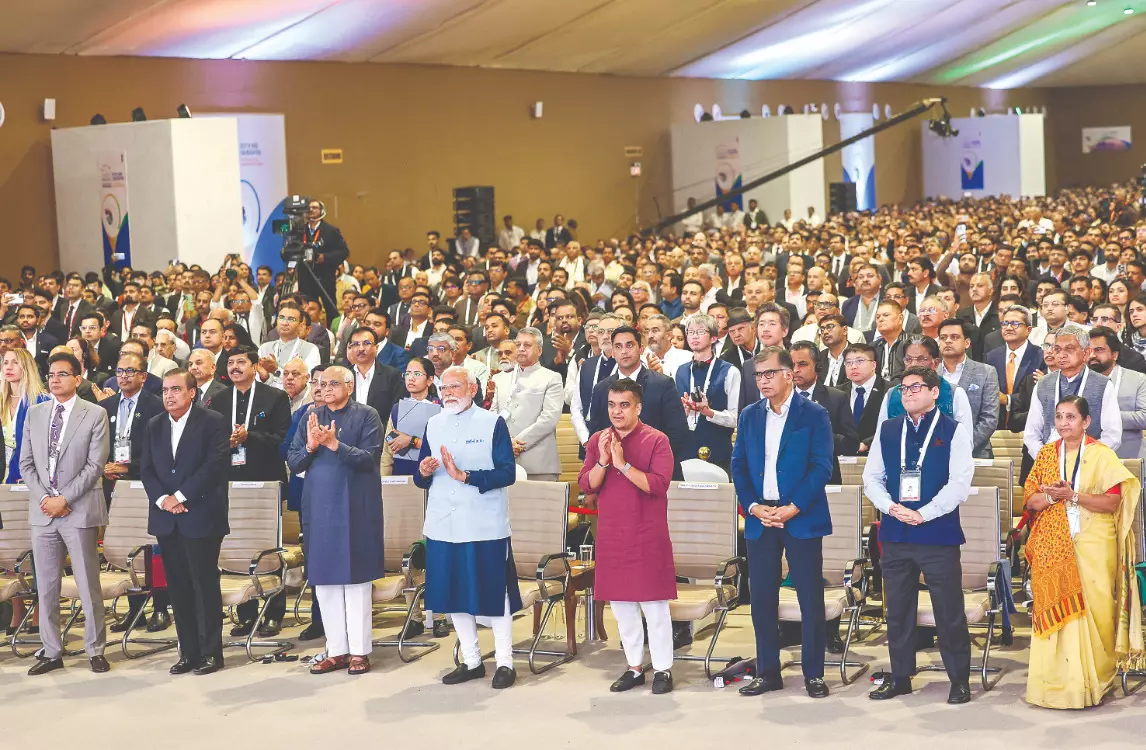


Rajkot/Somnath: Prime Minister Narendra Modi on Sunday projected India as a destination of policy continuity and political stability at a time of global turmoil, urging investors to seize “the right time” to expand in the country and specifically in Gujarat’s Saurashtra and Kutch region, while also delivering a forceful message at Somnath on the need to remain “alert, united and strong” against forces he said were still active in opposing India’s civilisational resurgence.
Speaking after inaugurating the Vibrant Gujarat Regional Conference (VGRC) for the Saurashtra and Kutch region in Rajkot, Modi said India was witnessing “an era of unprecedented certainty” despite what he described as “great global uncertainty”.
“Amidst great global uncertainty, we are witnessing an era of unprecedented certainty in India. Today, India has political stability and continuity in policies,” he said.
Modi said India was the world’s fastest-growing large economy and was moving steadily toward becoming the third-largest economy. “In recent years, India has made very rapid progress, and Gujarat has played a very significant role in this,” he said, adding that figures emerging in recent times showed that “the world’s expectations from India are constantly increasing”.
He pointed to the rise of a new middle class and its growing purchasing power as a major driver of possibilities in India. The prime minister said the country’s development was guided by the mantra of “Reform, Perform, and Transform”, adding that “every global expert and global institution” was bullish on India today.
Listing indicators of India’s expanding economic and technological footprint, Modi said India had become the world’s largest consumer of mobile data, while the Unified Payments Interface (UPI) had emerged as the world’s number one real-time digital transaction platform. He also said India was among the top three countries in solar power generation, and its metro networks were among the top three in the world.
“That is why I keep saying that this is the time, and it’s also the right time for every investor in the country and the world to take advantage of these opportunities,” he said.
Modi urged investors to look beyond established industrial centres and consider the Saurashtra and Kutch region, which he said was emerging as a key hub in the Aatmanirbhar Bharat (Self-Reliant India) campaign.
“Saurashtra and Kutch have a huge role to play in making India a global manufacturing hub, and this role is market-driven, which is what instills the greatest confidence in investors,” he said. He described the region as “an anchor region” for India’s growth.
Highlighting the region’s industrial strengths, the prime minister said Alang in Bhavnagar district was the world’s largest ship-breaking yard where one-third of the world’s ships are recycled. He also said India was among the largest producers of tiles, with Morbi district making a significant contribution to the sector.
Modi said the Dholera Special Investment Region was evolving into a major centre for modern manufacturing, and announced that India’s first semiconductor fabrication facility was being set up in Dholera. He told investors that the region offered an early-mover advantage in future technologies.
“The infrastructure is ready, the policy is predictable, and the vision is long-term,” he said.
Earlier in the day, the prime minister inaugurated a trade show at Marwadi University in Rajkot ahead of the VGRC. Officials said more than 1,500 Memoranda of Understanding (MoUs) were expected to be signed with over 110 international buyers from 16 countries, including the United States and several nations from Europe. They also said more than 1,800 business meetings had been scheduled during the Reverse Buyer Seller Meet (RBSM) at the conference.
Leading corporations participating in the exhibition include Torrent Power Limited, KOSOL, Adani Green, Essar Group, Nayara Energy and Jyoti CNC, officials said. The trade show is spread across 26,000 square metres and features more than 400 exhibitors representing a wide range of sectors, including agro and food processing, fisheries, defence, energy, petrochemicals, engineering, ports and logistics.
While Rajkot’s focus remained on investment and industrial expansion, Modi’s address at Somnath later in the day moved to themes of civilisational resilience and national unity. Speaking at Somnath Swabhiman Parv in Gujarat’s Gir Somnath district, Modi said forces that had opposed the reconstruction of the Somnath temple after independence were “still active among us”, and warned that conspiracies were now being pursued through non-military means.
“Unfortunately, those forces which had opposed the reconstruction of the Somnath temple are still present in our country and they are very much active. Instead of swords, conspiracies are being hatched against India through other means,” he said.
“That is why we need to remain alert and united. We have to make ourselves more powerful to defeat such forces which are conspiring to divide us,” he said.
Modi used the Somnath temple’s history to underscore what he described as the enduring strength of faith and the futility of violence. Referring to the repeated attacks endured by the shrine, he said “the hearts of people can never be won at the point of a sword”.
He said Somnath’s 1,000-year story was not one of defeat but “victory and reconstruction”, recalling that the temple had been repeatedly ravaged beginning with Mahmud of Ghazni’s attack in 1026. Modi said the destruction of Somnath had not merely been about plunder, arguing that the religious motivation behind the attacks was deliberately obscured.
“Books were written to cover up the religious motivation, portraying it merely as ordinary loot,” he said.
“The Somnath temple was repeatedly destroyed. If the invasions had been solely for plunder, they would have stopped after the first major loot 1,000 years ago,” Modi said, adding that “the sacred deity of Somnath was desecrated” and attempts were made “to alter the very form of the temple”.
“And we were taught that Somnath was destroyed for the sake of loot! The true history of hatred, atrocity and terror was concealed from us,” he said.
He also referred to the post-Independence reconstruction of the temple, saying that when Sardar Vallabhbhai Patel took an oath to rebuild Somnath, the effort faced obstruction. Modi said objections were also raised when India’s first President, Dr Rajendra Prasad, came for the inauguration of the reconstructed temple in 1951.
Modi said the temple faced multiple attacks over centuries, from Mahmud of Ghazni to Mughal ruler Aurangzeb in the 17th and 18th centuries. He said rulers such as Mahmud Begda and Aurangzeb attempted to convert the temple into a mosque, but the shrine was rebuilt after every attack by devotees, including Malwa queen Ahilyabai Holkar.
“Civilisations that seek to advance by destroying others ultimately destroy themselves,” Modi said. He added that pilgrimage sites like Somnath taught that “the path of creation is long, but it is also the lasting path”.
Calling Somnath’s story a testament to the courage and sacrifice of ancestors, Modi said the fundamentalist invaders were now “reduced to pages of history” even as the temple flag continued to fly. He described the centuries-long struggle as unparalleled.
“Such a struggle spanning centuries, such prolonged resistance and such unwavering faith in one’s culture, it is difficult to find anything comparable in world history,” he said.
Modi also paid tribute to those who defended the temple, naming Veer Hamirji Gohil and Vegdaji Bhil among “many bravehearts” who sacrificed their lives. He said they did not receive due credit, alleging that some historians and politicians tried to “whitewash” the history of the invasions.
Earlier, the prime minister led a ‘Shaurya Yatra’, a ceremonial procession organised to honour those who died defending the Somnath temple. The one-km-long yatra featured a procession of 108 horses. Large crowds lined the route from Shankh Circle to Veer Hamirji Gohil Circle, greeting Modi as he stood on a specially designed vehicle accompanied by Gujarat Chief Minister Bhupendra Patel.
Modi also offered prayers at the temple and paid tributes to Sardar Patel, whose statue has been installed near the temple premises. A group of young priests, known as ‘rushi kumars’, walked alongside his vehicle playing damru, an instrument associated with Lord Shiva. At one point, Modi borrowed two damrus from a priest and played them while standing on the vehicle.
Taken together, the two public engagements on Sunday presented a dual message from Modi: India, he said, was a stable and opportunity-rich economy inviting global investment, while also requiring unity and vigilance to guard against divisive forces as it reasserts its historical and cultural legacy.