AI, ambition and scale: PM inaugurates India AI Impact Summit with 600 startups on show
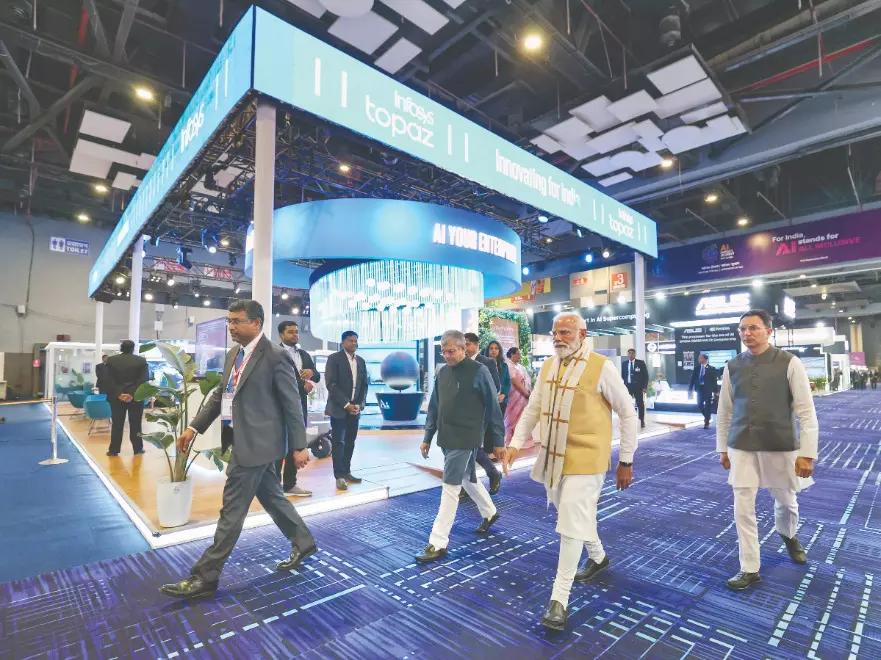


New Delhi: Prime Minister Narendra Modi on Monday inaugurated the five-day India AI Impact Summit and the accompanying India AI Impact Expo at Bharat Mandapam, marking what the government has described as the country’s largest edition of the global artificial intelligence gathering to date. The event brings together heads of state, senior policymakers, global technology executives, startups, researchers and civil society at a moment when AI is reshaping economies, labour markets and governance debates worldwide.
The summit and expo together span more than 70,000 square metres across 10 arenas within the sprawling complex. Officials said over 2.5 lakh registrations were received, with entry kept free upon registration. MeitY Secretary S Krishnan said the scale of interest exceeded expectations. “We never anticipated that there would be so many people willing and wanting to attend, which is why we did not restrict the registrations,” he said, adding that visitor passes were oversubscribed. The government has not released final attendance figures, though it expects around 2.5 lakh visitors over the week, including 20 national leaders and 45 ministerial-level delegations.
At the heart of the gathering is the India AI Impact Expo, which features more than 600 high-potential startups and over 300 curated exhibition pavilions and live demonstrations. Many of the startups are showcasing solutions already deployed in real-world settings, from healthcare and climate modelling to language technologies and public service delivery. The expo is organised around three broad themes, people, planet and progress, described by organisers as the guiding “sutras” of the summit. Thirteen country pavilions underline the event’s international character, with delegations from Australia, Japan, Russia, the United Kingdom, France, Germany, Italy, the Netherlands, Switzerland, Serbia, Estonia, Tajikistan and Africa presenting collaborative initiatives and research. Global technology firms, academic institutions, Union ministries, state governments and international partners are also participating.
During the inaugural day, Modi toured the exhibition halls, stopping at several stalls to interact with startup founders and company representatives. He was seen asking detailed questions about the technologies on display and spending several minutes at individual booths. In a post on X, he said, “Inaugurated the India AI Impact Expo 2026 at Bharat Mandapam. Being here among innovators, researchers and tech enthusiasts gives a glimpse of the extraordinary potential of AI, Indian talent and innovation. Together, we will shape solutions not just for India but for the world.”
Earlier in the day, the prime minister said the summit would “enrich global discourse on diverse aspects of AI, such as innovation, collaboration, responsible use and more,” and added that the turnout reflected India’s rapid progress in science and technology and the capabilities of its youth. He is scheduled to address the plenary session on Thursday, when the venue will be closed to general visitors.
The scale of participation, however, brought logistical challenges. From the opening morning, attendees reported long queues, overcrowding and confusion over access. Parts of the venue were cleared in the afternoon for security sanitisation ahead of high-level arrivals, with exhibitors asked to vacate at short notice. Some delegates told international news agencies that unclear instructions left them scrambling to retrieve belongings after exhibition halls were temporarily shut. Poor signage, limited seating and delays in confirming session agendas were also cited.
Startup founder Maitreya Wagh posted on X that he was unable to access his booth after gates were closed, adding that his team might set up an informal meeting point outside the venue. Others complained of long waits at food courts, difficulties accessing drinking water and vendors running out of supplies. One exhibitor alleged that wearable devices brought for display were stolen during the disruptions.
Organisers pointed to several innovations aimed at easing movement and services within the complex. A quick commerce platform established grocery and snack drop off points, while a food delivery company enabled in venue deliveries. Digi Yatra, typically used at airports, was piloted at entry gates to allow facial recognition based access.
Beyond the expo halls, the summit agenda includes more than 100 events, excluding sessions not livestreamed, covering issues from generative AI and defence applications to child safety, ethics, regulation and job disruption. Union Minister for Electronics and Information Technology Ashwini Vaishnaw said the objective was clear. “AI should be used for shaping humanity, inclusive growth and a sustainable future,” he said.
World leaders expected to attend include Emmanuel Macron and Luiz Inacio Lula da Silva. The speaker lineup features Sundar Pichai, Sam Altman, Brad Smith and Demis Hassabis. NVIDIA CEO Jensen Huang’s visit was cancelled over the weekend, and officials have not confirmed whether other listed speakers, including former Microsoft CEO Bill Gates, will attend.
Unlike early AI safety focused meetings held since 2023, the India edition is not expected to produce a binding political agreement. Officials say it is more likely to conclude with a nonbinding declaration outlining shared goals for global AI governance and collaboration, reflecting India’s bid to position itself as a bridge between advanced economies and the Global South.