Mamata leverages welfare, Bengali ‘asmita’ to combat anti-incumbency
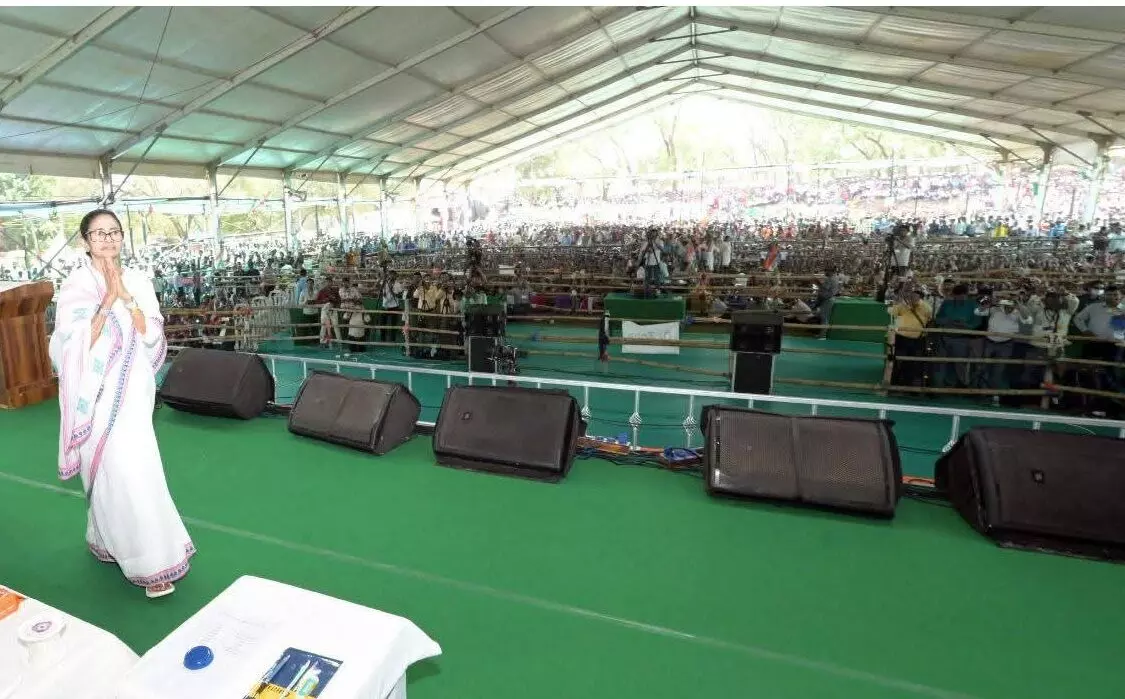


Kolkata: Trinamool Congress (TMC) supremo and Bengal Chief Minister Mamata Banerjee’s persona—marked by a blend of grassroots, street-fighting politics and an austere lifestyle—along with her direct emotional connect with voters, remains a key strength. This is reinforced by her government’s expansive welfare model.
However, in the ensuing Assembly polls, the ruling party faces the challenge of safeguarding its welfare-driven support base while countering corruption allegations against some of its leaders.
According to election analysts, the state government’s welfare schemes—spanning women, religious minorities, SCs and STs, and other marginalised sections—could continue to be decisive factors, potentially giving the ruling party an edge. The TMC chairperson and party’s national general secretary, Abhishek Banerjee, have focused their poll campaign on highlighting development and welfare initiatives, with schemes for women, minorities and the rural poor remaining central to the TMC’s strategy.
Data and field research indicate that these welfare schemes have helped Mamata Banerjee command loyalty among voters over the years. Moreover, Banerjee, for the first time, went beyond identity politics and stressed upon the delivery mechanisms.
She successfully turned the agrarian anger and sentiments of the people into a regime-changing force, and the Singur and Nandigram protests against land acquisition defined her political career. This time, the ruling party has foregrounded Bengali ‘asmita’, citing alleged attacks on Bengali-speaking migrant workers in BJP-ruled states, while canvassing the “outsider” narrative against the BJP. At most rallies, Mamata Banerjee has claimed that a BJP government would interfere with Bengalis’ food choices, including fish, eggs and meat.
Political analysts say that if Mamata Banerjee secures a fourth consecutive term despite strong anti-incumbency, she would emerge as a leading contender and key face of the INDIA bloc against the BJP at the Centre, further cementing her role as a prominent critic and challenger of Prime Minister Narendra Modi and a central figure in Opposition politics.
Recently, Sanjay Baru, former media advisor to Prime Minister Manmohan Singh, suggested Mamata Banerjee as a potential Prime Minister, calling her the most suitable candidate to become India’s second woman PM. Samajwadi Party chief Akhilesh Yadav has also backed Banerjee, describing her as a key leader of the opposition INDIA bloc to challenge the NDA government at the Centre.