Mamata calls SIR a ‘systemic failure,’ hints at ‘impeachment of CEC’


Delhi/ Kolkata: In a politically charged broadside likely to have ripple effects ahead of the Bengal polls, Chief Minister and Trinamool Congress (TMC) chairperson Mamata Banerjee on Tuesday escalating her attack on the Election Commission of India (ECI), branding the ongoing Special Intensive Revision (SIR) of electoral rolls a “systemic failure” and signalling the possibility of impeachment proceedings against Chief Election Commissioner (CEC) Gyanesh Kumar.
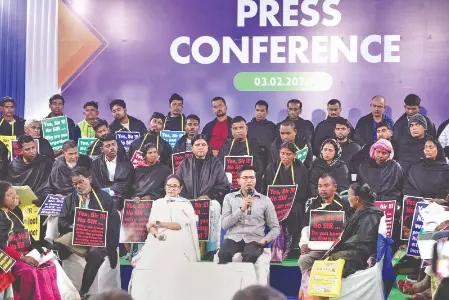
“If it is in the public interest, we (the TMC and other Opposition parties) can work together. I also want impeachment,” Banerjee said while responding to questions at a Press conference in the national capital, on Tuesday, a day after meeting the CEC.
Accusing the ECI of undermining the fundamental right to vote, Banerjee alleged that the SIR exercise was being carried out without due process, transparency, or adequate opportunity for affected voters to appeal. She described the exercise as tantamount to a “super emergency” being imposed in West Bengal.
Citing her own constituency, Bhawanipore, Banerjee alleged selective and large-scale deletions. “Bhawanipur has around 2.21 lakh voters. First, 40,000 voters were deleted unilaterally. In constituencies won by the TMC, 70,000 to one lakh voters are planned to be deleted in the name of ‘logical discrepancies’. But in BJP-won constituencies, the figure is as low as 2,000, 3,000, or at most 11,000,” she said.
She further claimed that the Electoral Registration Officers (ERO) association had written to state authorities stating they had no knowledge of the deletions. “They were never consulted. Names were deleted without their involvement,” Banerjee alleged, accusing a “BJP-minded official,” Seema Khanna, of carrying out deletions from within the Election Commission’s office using artificial intelligence.
Calling the entire process “bogus,” Banerjee rejected the CEC’s claim that the TMC had demanded the removal of duplicate voters. “Yes, we raised the issue—but in a specific context,” she clarified.
“We pointed out cases where the names of 25 voters from Haryana or 30 voters from Ghaziabad were tagged to a single voter in Bengal. We asked the ECI to clean the list, not to delete genuine voters of West Bengal.” Banerjee alleged that voters were neither properly informed nor given a fair opportunity to object through statutory mechanisms such as Form 6 or Form 7. “People have been deleted overnight. They were not given a chance to explain, object, or defend themselves,” she said, questioning the legality of the exercise.
She was accompanied at the press conference by members of nearly 90 families whose names were allegedly struck off the electoral rolls. Highlighting what she described as serious human consequences, Banerjee claimed that stress and uncertainty caused by the SIR had led to more than 150 deaths due to trauma and despair.
Pointing to glaring anomalies, Banerjee said several living individuals—among them Nandalal Ram, Bakul Chaudhuri Ari, Surajit Sardar, Jannatun Khatun, and Someshwar Karmakar—were marked as deceased in the revised rolls, underscoring what she termed the “mechanical and flawed” nature of the process.
She alleged that the SIR was being disproportionately implemented in opposition-ruled, election-bound states such as West Bengal, Bihar, and Kerala, while similar exercises were absent in BJP-ruled states like Assam. According to Banerjee, nearly 58 lakh names had already been deleted in a single phase, without sufficient notice or time for objections.
Questioning the timing of the exercise, Banerjee said: “The last Special Intensive Revision was conducted in 2002. After 23 years, why now, and why just before elections?”
Echoing her concerns, TMC national general secretary Abhishek Banerjee alleged a severe lack of transparency in the revision process. He claimed that multiple lists citing deletions due to “mismatches,” “mismapped entries,” and “logical discrepancies” had been prepared but were not made publicly accessible.
“Lists are either uploaded at selective locations or kept in offices where common citizens cannot access them,” Abhishek Banerjee said. “If people don’t even know their names are being deleted, how will they defend themselves?” he asked.
He added that the absence of booth- or ward-level publicly displayed lists marked a sharp departure from established electoral practices.
Banerjee further alleged that West Bengal was the only state where roll observers and nearly 8,100 -micro-observers had been appointed “illegally,” bypassing the authority of District Election Officers, Electoral Registration Officers, and Assistant EROs.
She also criticised the Election Commission’s role on BLOs (Booth Level Officers) payments, saying the West Bengal government has already paid Rs 60 crore to BLOs and that if the EC pays the remaining amount due, the state will clear its share too. Banerjee raised this to highlight what she described as the poll body’s failure to settle liabilities related to the SIR process.
According to her, the ultimate aim was to delete nearly two crore voters from the electoral rolls. She also claimed that despite a Supreme Court direction to display discrepancy lists, the ECI merely altered terminology—from “logical discrepancies” to “mismatch” and “mismapped”—without changing the nature of deletions.
Questioning the role of roll observers, Banerjee said the Representation of the People Act did not grant them decision-making authority at this stage of the SIR, yet they had emerged as the “real decision-makers.”
Alleging that daily instructions were being issued through WhatsApp instead of formal channels, Banerjee termed the process “worse than the NRC,” warning that it was eroding public trust in democratic institutions. “This is not about political competition,” she said. “It is about the arbitrary denial of the right to vote.”